The Vaginal Microbiome: Why It Matters for Health
There is an entire ecosystem living in your vagina, and it has been quietly determining the state of your vaginal health your whole life without anyone ever explaining it to you. Whether you get recurrent infections, why antibiotics sometimes make things worse before they get better, why sex can trigger symptoms, why your discharge changes after your period, why some women are more prone to bacterial vaginosis than others: the answer to all of these questions lives in the vaginal microbiome. Understanding it does not require a science degree. It requires someone to take the time to explain it clearly, which is what this article is here to do.
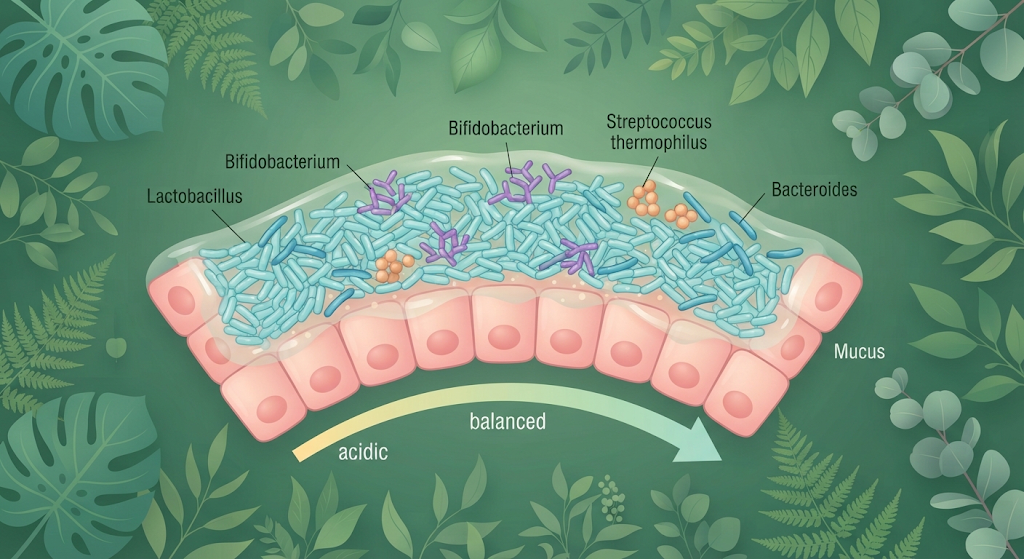
The vaginal microbiome is the community of microorganisms living in the vagina, dominated in most healthy women by Lactobacillus bacteria that produce lactic acid and maintain an acidic pH of approximately 3.8 to 4.5. This acidity protects against harmful bacteria and reduces infection risk. When this balance is disrupted, whether by antibiotics, sexual activity, hormonal changes, or hygiene products, the protective environment breaks down, increasing vulnerability to bacterial vaginosis, thrush, and sexually transmitted infections. Protecting the vaginal microbiome is one of the most concrete things a woman can do for her long-term vaginal health.
What the Vaginal Microbiome Is
A microbiome is a community of microorganisms, including bacteria, fungi, and viruses, that inhabit a particular environment in the body. The gut microbiome is the most widely discussed, but the vaginal microbiome is equally important for health and considerably less understood by most women.
Unlike the gut microbiome, which is characterised by enormous diversity and where variety is considered a marker of health, the vaginal microbiome is healthiest when it is dominated by relatively few species, primarily from the genus Lactobacillus. The most important species are Lactobacillus crispatus, Lactobacillus iners, Lactobacillus gasseri, and Lactobacillus jensenii, with L. crispatus considered the most protective.
These bacteria produce lactic acid through the fermentation of glycogen secreted by vaginal epithelial cells. The lactic acid maintains the vaginal pH in the mildly acidic range of 3.8 to 4.5. This acidic environment is inhospitable to most pathogens and creates a significant natural defence against infection.
Research has classified vaginal microbiome communities into community state types (CSTs). CST I, dominated by L. crispatus, is associated with the lowest infection rates and the most stable vaginal environment. CST III, dominated by L. iners, is associated with somewhat less stability. CST IV is the most diverse community type and corresponds to a Lactobacillus-depleted state, which is associated with higher rates of bacterial vaginosis, higher risk of acquiring sexually transmitted infections, and greater susceptibility to other vaginal conditions.
What Disrupts the Vaginal Microbiome
Several common factors can shift the vaginal microbiome away from a Lactobacillus-dominated state.
Antibiotics are among the most significant disruptors. While antibiotics target the specific pathogen causing an infection, they simultaneously affect the Lactobacillus population. This is why many women develop thrush (Candida overgrowth) during or after a course of antibiotics: with the bacterial competition reduced, yeast can multiply more readily. It is also why treating bacterial vaginosis with antibiotics can sometimes be followed by recurrence once the antibiotic course ends and the microbiome has not re-established its Lactobacillus dominance.
Sexual activity raises vaginal pH, partly because semen has an alkaline pH of approximately 7.2 to 8. Repeated or frequent unprotected intercourse can persistently elevate vaginal pH, creating conditions less favourable to Lactobacillus. This is one explanation for why BV is more common in sexually active women and why it is sometimes categorised as a sexually associated condition, though it is not an STI. Female-to-female sexual transmission of BV-associated bacteria has also been documented.
Hormonal changes directly affect the vaginal microbiome because Lactobacillus species depend on glycogen from the vaginal epithelium as their fuel source, and glycogen production is oestrogen-dependent. This is why vaginal microbiome stability shifts across the menstrual cycle, why women in the low-oestrogen perimenopausal and postmenopausal years are more susceptible to vaginal dysbiosis, and why breastfeeding women, who have reduced oestrogen while nursing, often experience vaginal dryness and increased susceptibility to infection.
Hygiene practices including douching, using scented soaps inside the vaginal opening, scented washes, bath bombs, or any product that enters the vaginal canal can disrupt the acidic pH and alter the microbial balance. The internal vagina does not need washing. External vulvar cleaning with warm water is sufficient. Products marketed as feminine hygiene solutions, particularly those with fragrances or alkaline pH, frequently do more harm than the microbiome they claim to support.
Menstrual blood is slightly alkaline and raises vaginal pH during a period, which may explain why BV symptoms are sometimes more noticeable around menstruation. Menstrual products do not themselves disrupt the microbiome when used appropriately.
Probiotics: What the Evidence Shows
The evidence for vaginal probiotics is promising but not yet definitive enough to make strong clinical recommendations.
Oral probiotics containing L. crispatus or L. rhamnosus GR-1 and L. reuteri RC-14 have been studied for their ability to colonise the vagina and reduce BV recurrence. Some studies show meaningful reductions in BV recurrence rates when oral probiotics are taken alongside or following antibiotic treatment. Vaginal probiotic formulations are also available in some countries.
The challenge is that vaginal microbiome colonisation is influenced by many individual factors including genetics, immune function, and the existing microbial community, and not all probiotics colonise equally well in all women. A probiotic that works well for one woman may have a limited effect in another with a different microbial baseline.
The practical guidance currently is that a high-quality oral Lactobacillus probiotic is unlikely to cause harm, may assist microbiome recovery after antibiotic treatment, and may help reduce BV recurrence in women who experience it repeatedly. It is not a substitute for antibiotic treatment of active BV and is not a replacement for the broader environmental factors that support vaginal health.
Why the Vaginal Microbiome Matters Beyond Infection
The implications of vaginal microbiome health extend beyond immediate infection risk.
Research has shown that women with Lactobacillus-depleted vaginal microbiomes have higher rates of acquisition of sexually transmitted infections including HIV, herpes simplex virus, and human papillomavirus (HPV). The acidic, Lactobacillus-rich environment appears to provide a genuinely protective effect against these pathogens.
In fertility and pregnancy, the vaginal microbiome also plays a role. A Lactobacillus-dominated microbiome at the time of embryo transfer in IVF is associated with higher implantation success rates. Vaginal dysbiosis in pregnancy is associated with higher rates of preterm birth, likely through ascending infection. Emerging research is examining the microbiome’s role in endometrial receptivity and in the uterine microbiome, which is a newer and still developing area of investigation.
FAQ
Can I test my own vaginal microbiome?
Vaginal microbiome testing is available through some specialist clinics and commercial testing companies, which offer at-home swabs sent to a laboratory for bacterial sequencing. This can identify the microbial community type and flag whether Lactobacillus species are dominant or depleted. Clinical interpretation of these results is still an evolving field, and while they can be informative, they are not yet a standard part of routine care in most healthcare systems. If you have recurrent vaginal infections, a conversation with a specialist in vulvovaginal health is often more actionable than commercial microbiome testing alone.
Does diet affect the vaginal microbiome?
There is emerging evidence that diet influences the vaginal microbiome indirectly through its effect on systemic oestrogen levels, immune function, and gut microbiome composition. Diets high in refined sugar may promote Candida overgrowth. Some research suggests that higher consumption of fermented foods and prebiotics supports both gut and potentially vaginal Lactobacillus populations. The direct evidence remains limited, but a diet that supports overall gut health and hormonal balance is likely to have positive downstream effects on the vaginal microbiome as well.
Is BV contagious, and should my partner be treated?
BV is not classified as a sexually transmitted infection, though it is sexually associated. The bacteria involved, including Gardnerella vaginalis and Prevotella species, can be transmitted through sexual contact, and there is evidence of shared bacterial communities between sexual partners. Male partners are not typically treated, as they do not develop symptoms and current evidence does not show that treating male partners reduces BV recurrence in women. For female partners, there is some evidence of benefit from simultaneous treatment, and this is worth discussing with a clinician in the context of recurrent BV in same-sex relationships.
Can using a hormonal IUD affect the vaginal microbiome?
Current evidence suggests that the hormonal IUD (levonorgestrel-releasing intrauterine system) has a relatively neutral to modestly positive effect on the vaginal microbiome in most women, and is not associated with increased BV risk in the way that some other contraceptive methods might be. The copper IUD is associated with a modest increase in BV risk in some studies, possibly related to the inflammatory environment copper creates in the uterus. Individual responses vary, and any new vaginal symptoms after IUD insertion should be reviewed rather than assumed to be the device.
Your Vaginal Health Has an Ecosystem. Mayno Helps You Understand It.
The vaginal microbiome is not a fringe topic. It is central to infection prevention, fertility, and long-term reproductive health. The more clearly you understand it, the better placed you are to support it, and to recognise when it needs help. Mayno is here to give women the knowledge that has for too long been kept in textbooks rather than shared clearly and openly.
Visit mayno.health for evidence-based women’s health guidance built around you.
This article is for informational purposes only and does not constitute medical advice. If you have concerns about vaginal health or recurrent infections, please consult a qualified healthcare professional. Mayno Health does not replace clinical care.
Disclaimer: This article is for informational purposes only and does not constitute medical advice. Always consult a qualified healthcare professional.