How the Menstrual Cycle Works: A Complete Guide
So many women have lived with their cycle for decades and still feel like they were never properly told how it actually works. You were given the basics at some point, probably rushed and incomplete, and then left to figure out the rest through experience, discomfort, and the occasional panic. The hormonal choreography behind every cycle is genuinely fascinating, and understanding it changes the way you relate to your own body. You stop feeling like your body is doing things to you, and start recognising the internal logic behind what you feel each month.
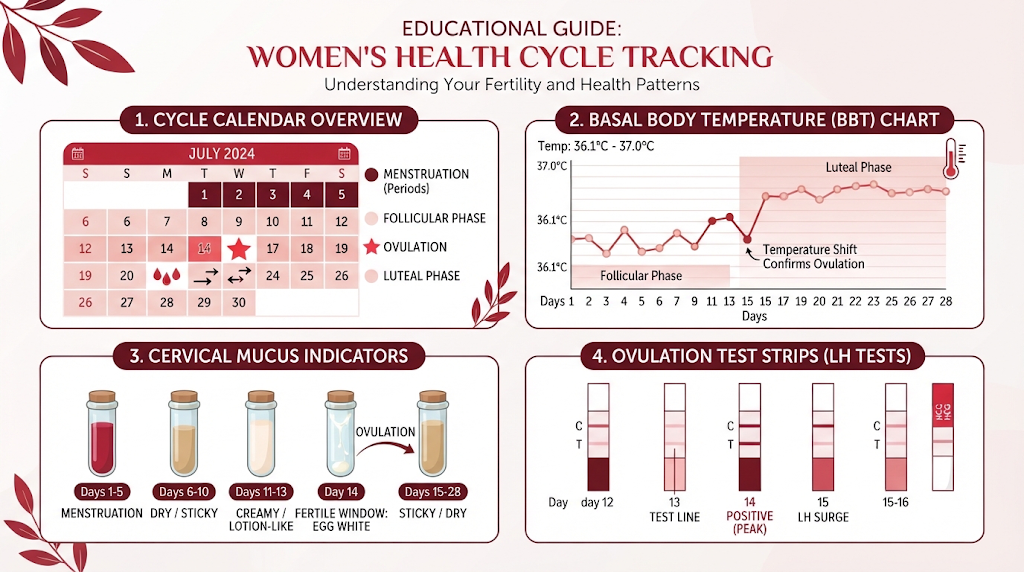
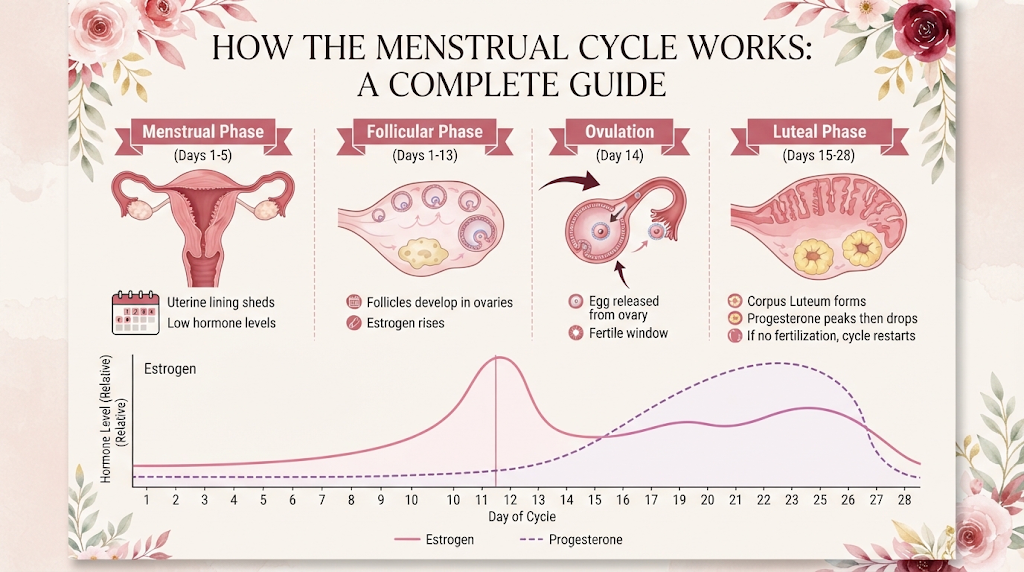
The menstrual cycle is divided into four phases: menstruation, the follicular phase, ovulation, and the luteal phase. It is driven by four key hormones: follicle-stimulating hormone (FSH), luteinising hormone (LH), oestrogen, and progesterone. These hormones rise and fall in a coordinated sequence that prepares the body for the possibility of pregnancy each cycle. A typical cycle lasts between 21 and 35 days, with bleeding lasting between 2 and 7 days. Cycle length varies between individuals and across a lifetime, and both ends of that range are considered normal.
The Four Phases of the Menstrual Cycle
Phase One: Menstruation (Days 1 to 5, approximately)
The first day of menstrual bleeding is officially Day 1 of the cycle. Menstruation occurs because the previous cycle did not result in pregnancy. When the hormone progesterone drops at the end of the luteal phase, the lining of the uterus (the endometrium) that had been built up in preparation for a fertilised egg is no longer maintained. That lining sheds, and this shedding is what causes the bleeding.
Bleeding typically lasts between 2 and 7 days. The flow may be heavier in the first two days and taper off. Some women experience cramping during this phase, caused by uterine contractions that help expel the lining. These contractions are triggered by hormone-like substances called prostaglandins. Higher prostaglandin levels are associated with more painful periods.
Phase Two: The Follicular Phase (Days 1 to 13, approximately)
The follicular phase actually overlaps with menstruation, beginning on Day 1 and continuing until ovulation. During this phase, the pituitary gland in the brain releases follicle-stimulating hormone (FSH). As its name suggests, FSH stimulates the ovaries to develop follicles, each of which contains an immature egg. Usually between 5 and 20 follicles begin developing in response to FSH.
As the follicles grow, they produce oestrogen. Oestrogen does several things during this phase. It causes the uterine lining to thicken and prepare for a potential fertilised egg. It also suppresses FSH (a feedback loop that prevents too many follicles from fully maturing), and it signals to the cervix to produce the kind of mucus that helps sperm move more easily. By around Day 10, one follicle has usually become dominant, producing the most oestrogen and outpacing the others, which gradually stop developing.
Rising oestrogen is also responsible for the relative energy and lift in mood that many women notice in the days leading up to ovulation.
Phase Three: Ovulation (Around Day 14, but variable)
When oestrogen reaches a certain threshold, it triggers a surge in luteinising hormone (LH) from the pituitary gland. This LH surge is the trigger for ovulation: the dominant follicle releases its mature egg into the fallopian tube.
The egg is viable for fertilisation for approximately 12 to 24 hours after release. Because sperm can survive in the reproductive tract for up to five days, the fertile window actually spans the five days before ovulation and the day of ovulation itself.
Ovulation does not always occur on Day 14. In a 28-day cycle it often does, but cycle length varies, and ovulation shifts accordingly. In a 35-day cycle, ovulation might occur around Day 21. Stress, illness, significant changes in weight, and disrupted sleep can all delay or suppress ovulation in any given cycle.
Some women can feel ovulation as a mild one-sided ache in the lower abdomen, called mittelschmerz. Others notice a change in cervical mucus around this time, which becomes clearer and more stretchy, similar in texture to raw egg white.
Phase Four: The Luteal Phase (Days 15 to 28, approximately)
After the egg is released, the follicle that housed it transforms into a temporary structure called the corpus luteum. The corpus luteum produces progesterone, which becomes the dominant hormone of the second half of the cycle.
Progesterone has a different character to oestrogen. Where oestrogen tends to be energising, progesterone is stabilising and, in higher amounts, sedating. It raises the body’s resting temperature slightly (which is why basal body temperature tracking can be used to confirm ovulation has occurred), thickens the uterine lining further in preparation for implantation, and alters cervical mucus to become thicker and less penetrable.
If a fertilised egg does not implant in the uterine lining, the corpus luteum breaks down after around 12 to 14 days. Progesterone and oestrogen both fall. The drop in progesterone triggers the next period, and the cycle begins again.
The physical and emotional changes many women notice in the days before their period, including bloating, breast tenderness, mood shifts, food cravings, and fatigue, are associated with this progesterone-dominant phase and the hormonal drop that follows. These are recognised as premenstrual symptoms, and they vary considerably between individuals.
Cycle Length Variation: What Is Normal
A cycle length of 21 to 35 days is considered within normal range. Cycles shorter than 21 days or longer than 35 days consistently may warrant discussion with a healthcare provider. Occasional variation of a few days in either direction is common and does not usually indicate a problem. Cycles also change across a lifetime: they tend to be more irregular in the first few years after periods begin, more regular through the mid-reproductive years, and then more variable again in perimenopause.
Tracking Your Own Cycle
Tracking your cycle over three to six months builds a picture of what is typical for you, which is far more useful than comparing yourself to a textbook average. You can track the start and end date of each period, flow heaviness, any symptoms (cramping, mood changes, breast tenderness, discharge changes), and energy levels.
Apps, paper diaries, and wearable devices all support cycle tracking. For those trying to conceive or avoid pregnancy naturally, basal body temperature tracking and cervical mucus observation can be added. A consistent pattern over several months gives you and your healthcare provider useful information if anything changes.
FAQ
Can your cycle length change month to month?
Yes. Cycle length naturally varies, and a difference of a few days between cycles is entirely normal. Factors including stress, illness, travel, sleep disruption, significant weight change, and intense exercise can all affect cycle length in a given month. Consistent cycles that are regularly shorter than 21 days or longer than 35 days are worth discussing with a healthcare provider, but occasional variation is not usually a cause for concern.
What is the difference between oestrogen and progesterone?
Both are reproductive hormones produced primarily by the ovaries. Oestrogen rises in the first half of the cycle and drives follicle development, uterine lining growth, and the physical changes associated with the approach to ovulation. Progesterone rises in the second half of the cycle, after ovulation, and prepares the uterine lining for implantation while stabilising the environment hormonally. If pregnancy does not occur, both fall and menstruation begins.
Why do periods hurt?
Period pain is caused primarily by prostaglandins, hormone-like chemicals released as the uterine lining begins to shed. They cause the uterus to contract, which can restrict blood flow temporarily and produce cramping. Women with higher prostaglandin levels or greater sensitivity to them tend to experience more discomfort. Conditions including endometriosis and adenomyosis can cause significantly more severe period pain and are worth investigating if pain is regularly disruptive to daily life.
Is it possible to get pregnant during your period?
It is unlikely but not impossible. Sperm can survive in the reproductive tract for up to five days. For women with shorter cycles, ovulation can occur relatively soon after menstruation ends, meaning sperm present from intercourse during a period could still be viable when the egg is released. For most women with typical cycle lengths it is a low probability, but it is not zero, and it is worth understanding if cycle length and ovulation timing are not well established.
Understanding Your Cycle Is Understanding Yourself. Mayno Is Here to Help With That.
Your cycle is not just a monthly event. It is a running reflection of your hormonal health, and understanding its rhythms gives you a real advantage when something changes or something does not feel right. Mayno is here to make that knowledge accessible, clear, and genuinely useful to you.
Visit mayno.health for more women’s health guidance written for real women.
This article is for informational purposes only and does not constitute medical advice. If you have concerns about your menstrual cycle, please consult a qualified healthcare professional. Mayno Health does not replace clinical care.
Disclaimer: This article is for informational purposes only and does not constitute medical advice. Always consult a qualified healthcare professional.