How Female Fertility Works: A Clear Guide
Many women reach their thirties, or find themselves trying to conceive, and realise they were never taught how fertility actually works. The biology was covered briefly in school, usually focused on preventing pregnancy rather than understanding the process itself. If you want to move beyond vague notions of “the fertile window” and understand what your body is actually doing each month, you are in the right place. Fertility is not a mystery. It follows a clear hormonal sequence with its own logic, and understanding it changes how you think about your cycle, your body, and your options at every stage.
Female fertility depends on a coordinated monthly cycle in which a mature egg is released from one of the ovaries (ovulation), travels down the fallopian tube, and can be fertilised by sperm during a window of approximately five to six days. This process is driven by a precise sequence of hormones from the brain and ovaries. Fertility is at its peak in the early-to-mid twenties and declines gradually through the thirties, with a steeper decline after 35. Understanding this process allows women to make more informed decisions about conception, contraception, and reproductive health at every age.
The Menstrual Cycle and the Fertility Window
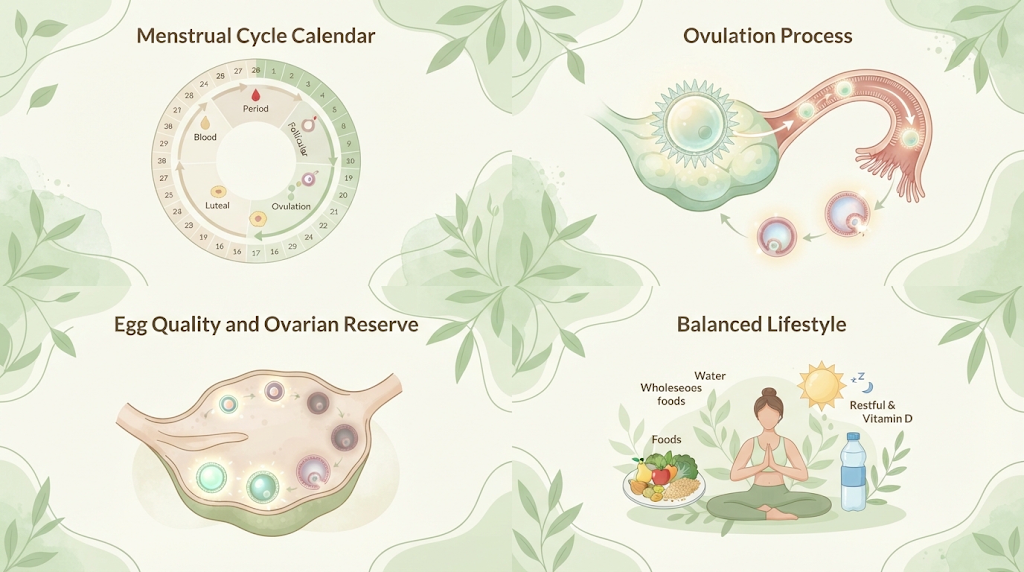
The menstrual cycle is the framework within which fertility operates. A typical cycle runs between 21 and 35 days, with 28 days being the statistical average, though natural variation across this range is entirely normal.
The cycle begins on day one of a period and is divided into two halves by ovulation. The first half is the follicular phase. The second half is the luteal phase. Ovulation is the event that separates them.
Conception is only possible during a window of approximately five to six days each cycle: the five days before ovulation (during which sperm can survive in the reproductive tract awaiting the egg) and the day of ovulation itself. The egg survives for only 12 to 24 hours after release, which is why the days leading up to ovulation, when sperm are already present, are as important as the day itself.
For a woman with a 28-day cycle, ovulation typically occurs around day 14. But for women with shorter or longer cycles, the timing shifts. Ovulation in a 24-day cycle may occur as early as day 10. In a 35-day cycle, it may not occur until day 21. This variability is why calendar-based methods alone are unreliable for both conception and contraception, and why understanding your individual cycle matters.
Ovulation Mechanics: What Actually Happens
Ovulation is triggered by a hormonal cascade that begins in the brain.
At the start of each cycle, the pituitary gland releases follicle-stimulating hormone (FSH). FSH stimulates a group of follicles in the ovary, each containing an immature egg, to begin developing. Over the following days, one follicle becomes dominant, growing larger than the others while producing increasing amounts of oestrogen. This rising oestrogen has two effects: it builds up the uterine lining, preparing it for potential implantation, and it signals to the pituitary gland that ovulation is imminent.
When oestrogen reaches a sufficient peak, the pituitary releases a large surge of luteinising hormone (LH). This LH surge is what triggers ovulation: within 24 to 36 hours, the dominant follicle ruptures and releases the mature egg. This is the moment that ovulation predictor kits detect, measuring the rise in urinary LH to identify the approach of ovulation.
The released egg is swept into the fallopian tube by finger-like projections called fimbriae. It travels through the tube toward the uterus, and if sperm are present, fertilisation typically occurs in the outer portion of the tube.
The Role of the Corpus Luteum
After the follicle ruptures and releases its egg, it does not simply disappear. It transforms into a structure called the corpus luteum, which plays a critical role in the second half of the cycle.
The corpus luteum produces progesterone, the hormone that prepares the uterine lining for implantation and maintains the early stages of a pregnancy if fertilisation occurs. Progesterone causes the uterine lining to become secretory and receptive, and it raises basal body temperature slightly, which is why a sustained rise in temperature after ovulation is used by those charting their cycles to confirm that ovulation has occurred.
If the egg is not fertilised, the corpus luteum begins to degrade after approximately 10 to 16 days, progesterone falls, and the uterine lining sheds as a period. The cycle then begins again.
If fertilisation does occur and an embryo implants, it produces human chorionic gonadotropin (hCG), which signals to the corpus luteum to continue producing progesterone and maintain the pregnancy until the placenta takes over this function at around 10 to 12 weeks.
What Ovarian Reserve Means
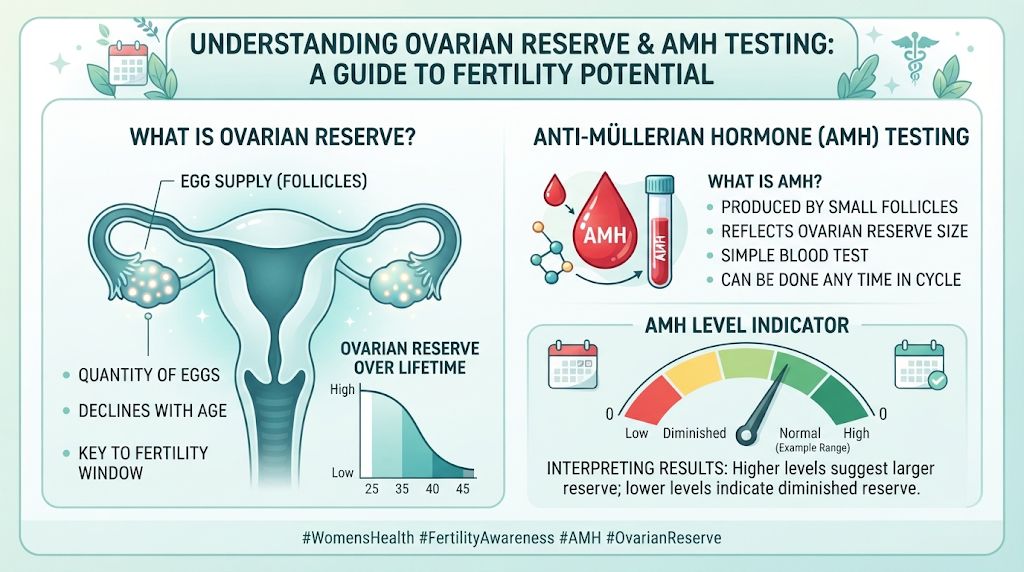
A woman is born with all the eggs she will ever have, approximately one to two million at birth. By puberty, this has declined to around 300,000 to 500,000 through a natural process of attrition. Each month, a cohort of follicles begins developing in response to FSH, but only one typically reaches maturity and is released. The rest undergo a process of regression. Over a reproductive lifetime, roughly 400 to 500 eggs are actually ovulated.
Ovarian reserve refers to the size and quality of this remaining egg supply. It is assessed in clinical practice using two main measurements: anti-Mullerian hormone (AMH), a blood test that reflects the overall pool of remaining follicles, and antral follicle count (AFC), an ultrasound measurement of the small follicles visible in the ovaries at the start of a cycle.
It is important to understand what these tests do and do not tell you. A low ovarian reserve indicates a smaller remaining pool of eggs and may mean the ovaries respond less strongly to fertility treatment stimulation. However, it does not reliably predict the ability to conceive naturally. Women with low AMH levels conceive spontaneously, and the tests are most useful in the context of planning IVF treatment rather than as standalone indicators of natural fertility.
Age and Fertility: An Honest Account
Fertility declines with age, and understanding how this happens helps women make genuinely informed decisions rather than acting on either false reassurance or unnecessary alarm.
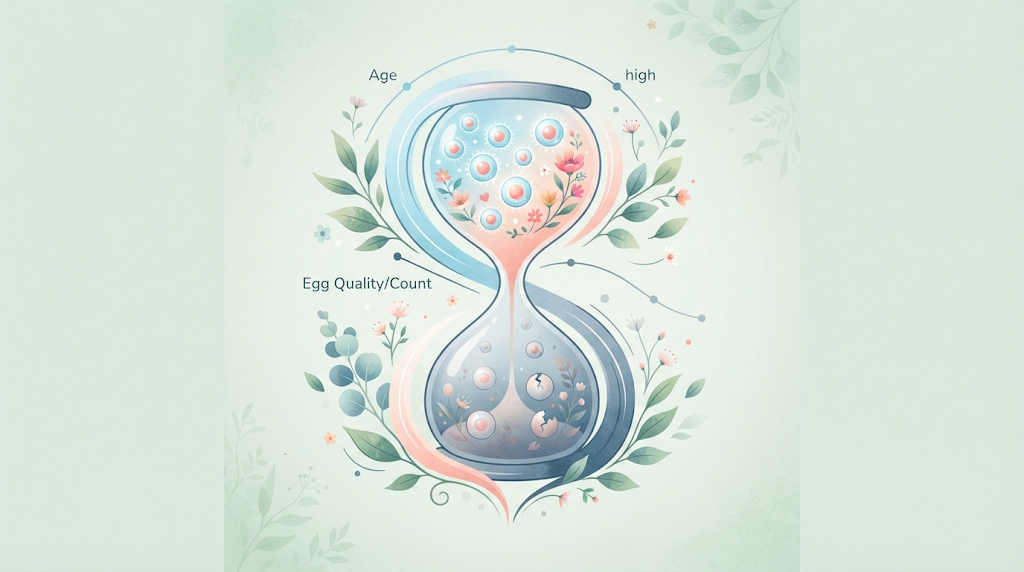
The decline is primarily related to egg quality rather than quantity alone. As eggs age, they are more likely to carry chromosomal abnormalities, which increases the risk of miscarriage and reduces the likelihood of a successful pregnancy. This process accelerates in the mid-to-late thirties.
Statistical data shows that natural fertility begins to decline gradually from the mid-twenties, with a more noticeable decline from around 32 to 35, and a steeper decline after 37. By the early forties, monthly conception rates per cycle are significantly lower than in the twenties, though natural conception absolutely still occurs.
These statistics describe populations, not individuals. A woman at 38 may conceive quickly and easily, while a woman at 28 may face significant fertility challenges. Age is one factor among many, though it is a clinically significant one that is worth weighing honestly when making decisions about timing.
Factors That Support or Reduce Fertility
Beyond age and ovarian reserve, several modifiable and non-modifiable factors influence fertility.
Supporting fertility: Maintaining a healthy weight within the normal BMI range supports hormonal balance and cycle regularity. Regular moderate exercise supports overall health without suppressing ovulation. A varied diet with adequate folate, vitamin D, and iron is associated with better reproductive outcomes. Avoiding smoking is one of the most evidence-supported steps a woman can take, as smoking accelerates egg loss and impairs ovarian function. Alcohol reduction is also recommended for women actively trying to conceive.
Reducing fertility: Conditions including PCOS, endometriosis, blocked fallopian tubes (often caused by previous pelvic infection), thyroid dysfunction, and hyperprolactinaemia all affect fertility through different mechanisms and warrant medical assessment and management. Significant weight loss, excessive exercise, and high levels of chronic stress can all suppress ovulation. Sexually transmitted infections, particularly chlamydia, can cause tubal damage if untreated, underscoring the importance of STI screening and treatment.
FAQ
How do I know if I am ovulating?
The most accessible signs of ovulation include a change in cervical mucus, which becomes clear, slippery, and stretchy resembling raw egg white in the days around ovulation, and a slight rise in basal body temperature after ovulation has occurred. Ovulation predictor kits detect the urinary LH surge 24 to 36 hours before ovulation and are a reliable way to time intercourse. Persistent cycle irregularity or the absence of these signs may suggest ovulation is not occurring regularly and warrants medical review.
Can you get pregnant on any day of your cycle?
No. Conception is only possible during the fertile window, which covers the five days before ovulation and the day of ovulation itself. Outside this window, pregnancy is not possible in that cycle. The challenge is that the timing of ovulation varies between women and between cycles in the same woman, which is why identifying the fertile window through cycle tracking, cervical mucus observation, or ovulation predictor kits is more reliable than relying on fixed calendar dates.
Does coming off contraception affect fertility long-term?
For most women, hormonal contraception does not have a lasting effect on fertility once it is stopped. Ovulation typically returns within one to three months of stopping combined pills, though it can take longer in some individuals. The contraceptive injection may delay the return of ovulation for several months beyond the last dose. There is no evidence that long-term contraceptive use permanently reduces fertility. A woman who has not conceived after 12 months of regular unprotected intercourse (or 6 months if over 35) should seek medical investigation regardless of previous contraception use.
What is the difference between infertility and subfertility?
Infertility is clinically defined as the failure to conceive after 12 months of regular unprotected intercourse in women under 35, or 6 months in women over 35. Subfertility describes a reduced likelihood of conception rather than its complete absence, and covers a wide range of conditions including irregular ovulation, mild endometriosis, or mildly reduced sperm parameters. Many people given a subfertility diagnosis do conceive, either naturally over time or with relatively straightforward intervention. The distinction matters because it shapes the urgency and type of investigation recommended.
Understanding Your Fertility Is Understanding Yourself. Mayno Is Here for That.
Whether you are trying to conceive, thinking about your options for the future, or simply want to understand the biology behind your own cycle, knowledge is the most powerful tool you have. Mayno is built to give women that knowledge, clearly, compassionately, and without the guesswork.
Visit mayno.health to explore women’s health guidance that takes you seriously.
This article is for informational purposes only and does not constitute medical advice. If you have concerns about your fertility, please consult a qualified healthcare professional. Mayno Health does not replace clinical care.
Disclaimer: This article is for informational purposes only and does not constitute medical advice. Always consult a qualified healthcare professional.