First Trimester: Week by Week Guide
The first trimester is one of the most significant periods in human experience, and also one of the loneliest. You may be carrying enormous news while looking completely unchanged from the outside, managing symptoms that affect your daily life while telling almost nobody why, and holding the weight of early pregnancy anxiety while trying to go about things as normal. If what you want right now is a clear, grounded guide to what is actually happening and what to expect, without unnecessary alarm or empty reassurance, this is it.
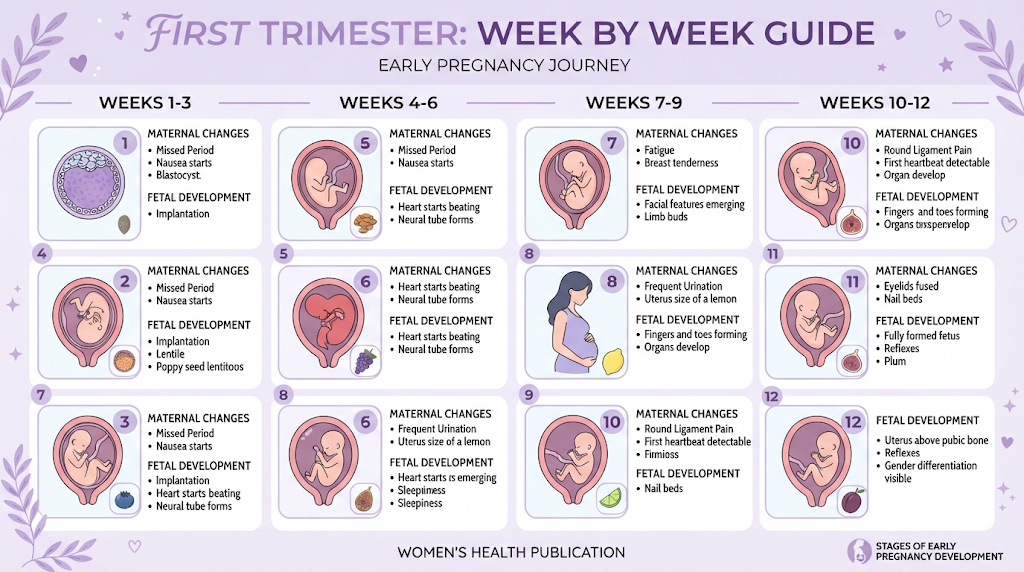
The first trimester covers weeks 1 to 12 of pregnancy, dated from the first day of the last menstrual period. During this period, the fertilised egg implants, the embryo forms all its major organ systems, and by week 12 has become a recognisable foetus measuring around 6 centimetres. The most common symptoms are fatigue, nausea, breast tenderness, and frequent urination, driven by rapidly rising hCG and progesterone. The risk of miscarriage falls significantly after a heartbeat is confirmed at an early scan and again after week 12. Most antenatal care begins during this trimester with a first appointment between weeks 8 and 12.
Weeks 1 to 4: Before You Know
Weeks 1 and 2 are technically counted before conception occurs. The cycle begins, ovulation happens, and fertilisation takes place. By week 3, the fertilised egg is travelling towards the uterus and beginning to divide rapidly, forming a blastocyst. Implantation in the uterine lining occurs between days 6 and 10 after fertilisation.
By week 4, the blastocyst has embedded in the uterine lining and split into two parts: one becomes the embryo, the other the placenta. The amniotic sac begins to form. hCG production starts, which is what a pregnancy test detects. Some women notice very light spotting (implantation bleeding), mild cramping, or early breast tenderness at this stage. Many notice nothing at all.
Weeks 5 to 6: The Heart Begins to Beat
By week 5, the embryo is the size of a sesame seed, but it already has a developing neural tube (which will become the brain and spinal cord), a forming heart, and the beginnings of the circulatory system. hCG levels are rising rapidly, doubling approximately every 48 to 72 hours.
Week 6 is when many women first notice clear symptoms. Nausea often begins here. Fatigue can become significant. Breast tenderness may intensify. Frequent urination picks up as blood flow to the kidneys increases.
At week 6, an early ultrasound (often called a viability scan and not routinely offered in all healthcare systems) can usually detect a heartbeat. Seeing a heartbeat at this stage is a reassuring sign, though it does not eliminate all risk of miscarriage.
Weeks 7 to 8: Rapid Development
By week 7, the embryo has a distinct head, a developing face, and small limb buds that will become arms and legs. The brain is developing rapidly. All major organ systems are forming simultaneously during this period, which is why the first trimester carries heightened sensitivity to certain substances and infections.
Week 8 is often the peak of first trimester symptoms. Nausea may be at its most intense. Fatigue can feel relentless. Some women also notice food aversions (an inability to tolerate previously enjoyed foods) and heightened sense of smell, both of which are thought to be triggered by rising oestrogen.
The embryo at week 8 is around 1.6 centimetres and has discernible facial features, visible fingers and toes beginning to form, and a heart beating at roughly 150 to 170 beats per minute.
Weeks 9 to 10: From Embryo to Foetus
At week 9, the term embryo transitions officially to foetus. All the essential structures are in place; what follows is growth and refinement. Muscles begin to develop. The foetus can make small spontaneous movements, though these are not yet felt by the mother.
By week 10, fingernails are forming, the kidneys are producing urine, and the external genitalia are beginning to differentiate, though sex is not yet identifiable on a scan. The foetus is around 3 centimetres.
For many women, weeks 9 and 10 remain symptomatic. The placenta is not yet fully functional, so the body’s own hormone production is still doing the heavy work. Some women notice their symptoms beginning to ease slightly towards week 10 as the placenta starts to take over more hormonal responsibility.
Weeks 11 to 12: Approaching the Milestone
By week 11, the foetus has fully formed fingers and toes, functioning kidneys and liver, and is beginning to make swallowing movements. Week 12 marks the end of the first trimester. The foetus is now around 6 centimetres from head to bottom and is proportionally recognisable as a baby in miniature.
The 12-week mark is significant for several reasons. The risk of miscarriage drops considerably after this point, as the period of major organogenesis is complete. The nuchal translucency scan, which screens for chromosomal conditions including Down syndrome, is typically offered between weeks 11 and 14 depending on the healthcare system. Many women choose week 12 as the point at which they share their news more widely.
Symptoms and Their Causes
The physical experience of the first trimester is driven primarily by hCG and progesterone:
Nausea is associated with rising hCG and increased oestrogen. It peaks when hCG peaks, around weeks 8 to 10, and tends to ease as hCG begins to plateau and the placenta takes over.
Fatigue is driven by progesterone, increased metabolic demand, and the significant rise in blood volume the body begins managing from very early in pregnancy.
Breast tenderness and changes result from oestrogen and progesterone preparing the breast tissue. Areolae darken, veins become more visible, and breasts may feel noticeably heavier.
Frequent urination results from increased blood flow to the kidneys, which boosts their filtering activity, and from hCG affecting the bladder.
Bloating and constipation are caused by progesterone relaxing smooth muscle throughout the body, including in the digestive tract, which slows gut motility.
Headaches in early pregnancy are linked to hormonal changes and increased blood volume. Staying hydrated and maintaining blood sugar levels with regular small meals can help.
The Emotional Experience
The emotional landscape of the first trimester is complex and often underacknowledged. Anxiety about miscarriage is common and rational given that the first trimester carries the highest pregnancy risk. Many women describe feeling unable to fully invest emotionally in the pregnancy until after a scan or the 12-week mark, which is an entirely understandable protective response.
Mood changes are also driven by hormonal shifts, fatigue, and nausea. Feeling tearful, irritable, or overwhelmed more easily than usual is common. If low mood, persistent anxiety, or intrusive thoughts are significantly affecting daily functioning, speaking to a healthcare provider is worthwhile: perinatal mental health support is available in many healthcare systems and there is no reason to wait until after birth to access it.
What to Eat, Avoid, and Do
Eat: Small, frequent meals help manage nausea and blood sugar. Protein, complex carbohydrates, and iron-rich foods support increasing demands. Start folic acid (400 micrograms daily) if you have not already, through to at least 12 weeks. Vitamin D supplementation is recommended in many guidelines throughout pregnancy.
Avoid: Alcohol at any level, raw or undercooked meat and eggs, unpasteurised cheeses and dairy, raw shellfish, high-mercury fish (shark, swordfish, marlin, king mackerel), and liver and liver products (due to high vitamin A levels). Caffeine is not prohibited but most guidelines recommend limiting intake to under 200mg per day (roughly one to two cups of coffee).
Do: Attend all scheduled antenatal appointments. Rest when possible. Continue or begin gentle exercise unless advised otherwise. Discuss all existing medications with your healthcare provider before stopping or changing anything.
Who to Tell and When
There is no universal right answer. Many women wait until after the 12-week scan to share the news widely, both because this is when risk drops most significantly and because having confirmation of a viable pregnancy in hand makes telling people feel more grounded. Others tell close family or friends earlier for practical support, particularly if symptoms are significant.
Your decision about when to share is personal and does not need to follow a timeline imposed from outside. The people you would want to support you if a pregnancy were lost are often the right people to tell early.
FAQ
Is it normal to have no symptoms in the first trimester?
Yes. Symptom intensity varies significantly between women and between pregnancies. Some women feel profoundly unwell throughout the first trimester; others have minimal symptoms. The absence of nausea or fatigue does not indicate that the pregnancy is not progressing. If symptoms that were previously present disappear suddenly, particularly with bleeding or pain, contact a healthcare provider. But the absence of symptoms in a woman who has had few to begin with is not independently a cause for alarm.
When does the risk of miscarriage drop?
Risk falls after a heartbeat is confirmed on an early scan, and again significantly after week 12. Before 12 weeks, the risk of miscarriage in all recognised pregnancies is estimated at around 10 to 20 percent across the general population. After week 12 it drops to roughly 1 to 5 percent for ongoing pregnancies. Risk is higher in older maternal age groups. These figures are population-level and cannot predict individual outcomes.
Can I exercise in the first trimester?
For most women with uncomplicated pregnancies, moderate exercise is safe and beneficial throughout the first trimester. Walking, swimming, yoga, and low-impact activity are generally well tolerated. Very high-intensity training, contact sports, and activities with a fall risk are best avoided or modified. If you were exercising regularly before pregnancy, you can generally continue at the same level with some modifications. If in doubt, discuss your exercise plan with your midwife or doctor at your first appointment.
What happens at the 12-week scan?
The 12-week scan (usually offered between weeks 11 and 14, depending on the healthcare system) checks that the foetus is developing normally, measures the foetus to confirm the due date, checks for a heartbeat, and looks for a multiple pregnancy. It is also typically when nuchal translucency measurement is taken as part of first-trimester screening for chromosomal conditions. The scan involves an ultrasound, usually performed on the abdomen, sometimes transvaginally if the image is clearer that way.
You Are Not Navigating This Alone. Mayno Is With You.
The first trimester is a lot to hold, physically and emotionally. Having access to clear, trustworthy information makes a real difference when you are trying to make sense of what is happening in your body and what comes next. Mayno is here for every question, every week, every stage.
Visit mayno.health for pregnancy guidance written with care for real women.
This article is for informational purposes only and does not constitute medical advice. If you are pregnant, please attend all scheduled antenatal care appointments and consult a qualified healthcare professional with any concerns. Mayno Health does not replace clinical care.
Disclaimer: This article is for informational purposes only and does not constitute medical advice. Always consult a qualified healthcare professional.